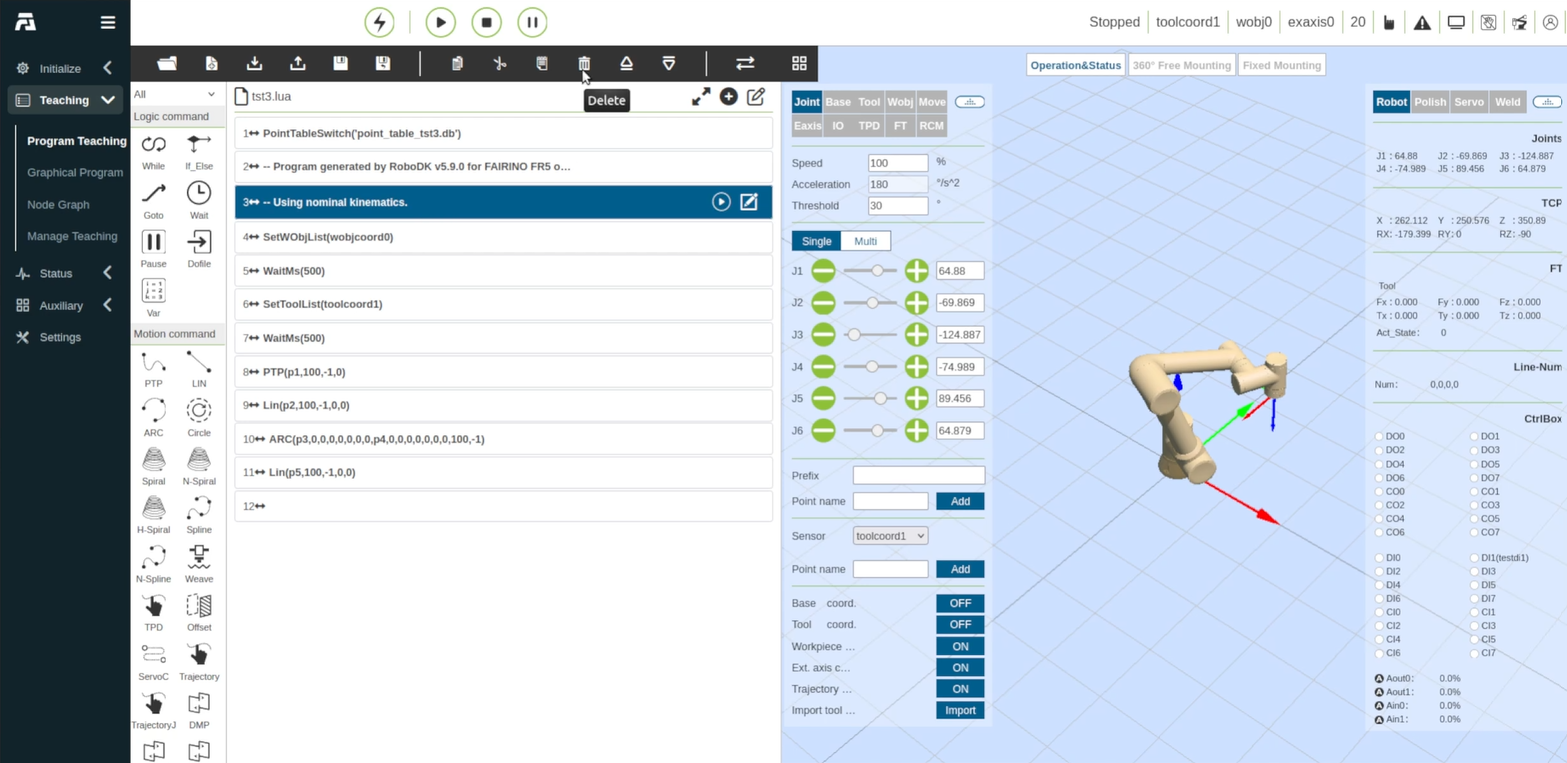
Transfer and Load a Program
To run programs created in RoboDK, both the Lua script and the corresponding point table database file must be imported into the FAIRINO Collaborative Robot Console.
Import the Program Script
The first step to run RoboDK programs on a FAIRINO robot includes importing the Lua script. Follow these steps to import the .lua file into the console.
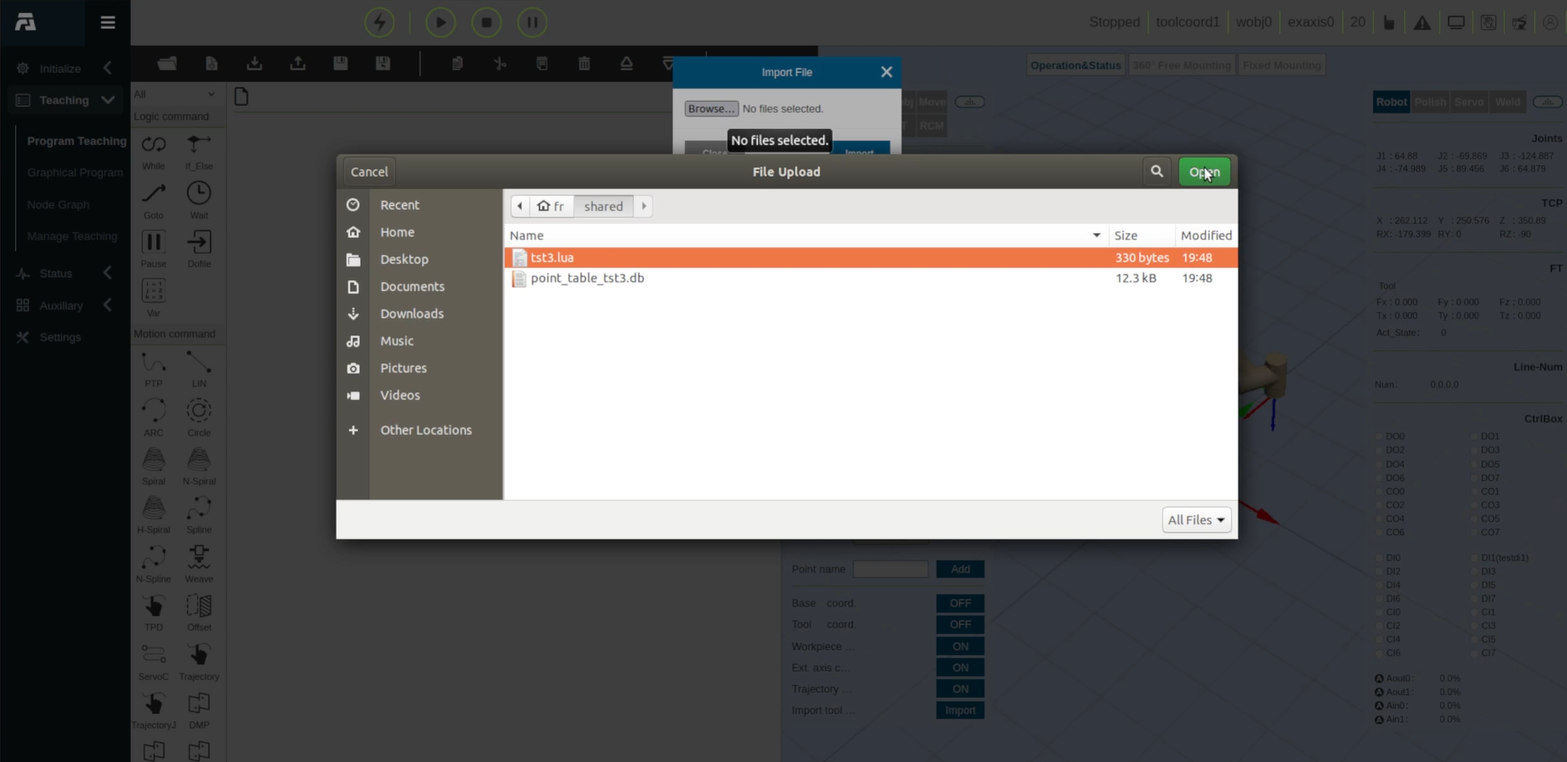
1.From the top toolbar in the Program Teaching screen, click the Import icon.
2.In the Import File dialog, click Browse....
3.In the file browser dialog, navigate to the target folder and select the script file (e.g., tst3.lua in the screenshot that follows).
4.Click Open, then click Import to upload the file to the console.
Import the Point Table
The second step is to load the point table .db file into the console. Follow these steps to import the point table.
1.On the left-hand navigation sidebar, click on Manage Teaching.
2.Under the Teaching Management view, select the Point table mode radio button at the top.
3.Click the green Import button located next to the point addition controls.
4.In the Import File popup, click Browse....
5.Select the point table database file (e.g., point_table_tst3.db) and click Open.
6.Click Import in the dialog box to finish uploading.
7.In the upper-right corner of the Teaching Management panel, locate the Select point table dropdown menu.
8.Select the imported table (e.g., point_table_tst3.db).
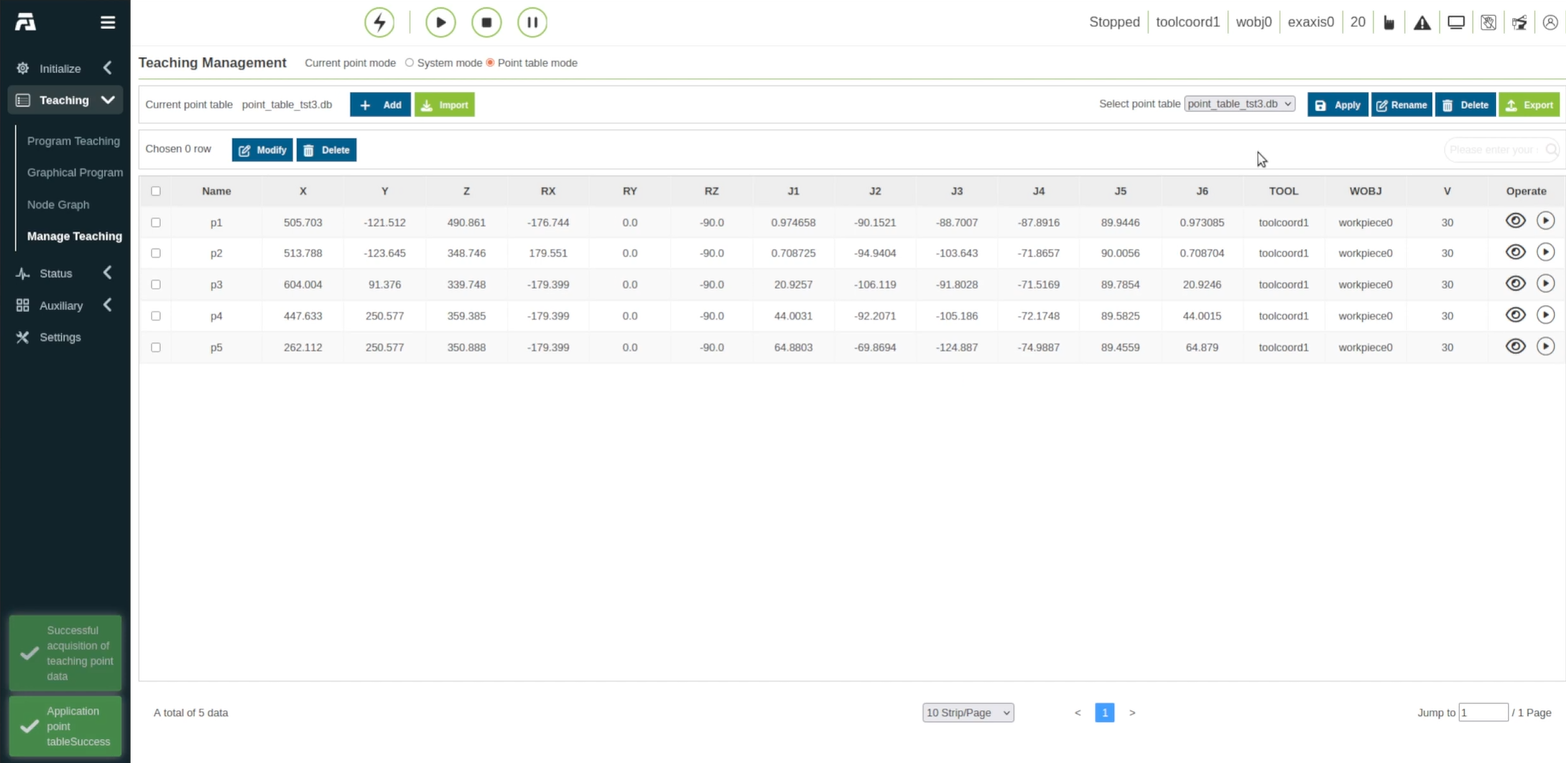
9.Click the blue Apply button. The point list table will populate with the imported coordinate points (p1 to p5) including their Cartesian parameters (X, Y, Z, RX, RY, RZ), joint values (J1–J6), Tool index, and Workpiece frame as shown below.
Prepare the Program
The final step before you run the imported program for the FAIRINO robot is to clean it up and remove unnecessary program lines. Follow these steps to clean up and make the program executable.
1.Return to the Program Teaching screen by selecting it from the left sidebar.
2.Click the Open File icon on the top program toolbar.
3.In the Open File dialog, select the program file (e.g., tst3.lua) from the list.
4.Click Open to load the program blocks into the editor.
5.Review the loaded program blocks.
6.Select any line you do not need on the controller, such as the comment blocks RoboDK writes at the top of the program (for example, -- Program generated by RoboDK and -- Using nominal kinematics.).
7.Click the Delete (trash can) icon in the editing toolbar to remove the block.