



03-17-2026, 07:25 AM
Hi,
I am working on a filament winding simulation in RoboDK.
My setup is:
- A 6-axis KUKA robot
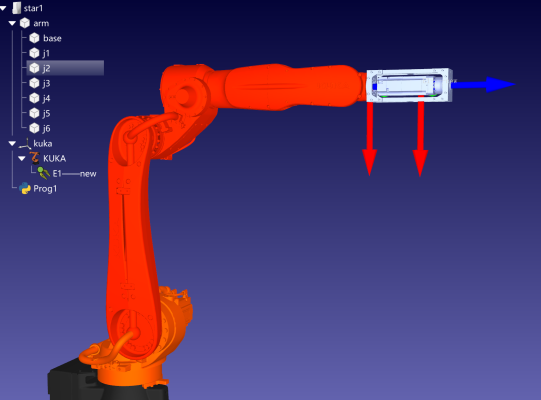
- An additional rotary axis (E1) mounted directly on the robot wrist (A6)
- The mandrel is attached to this E1 axis
The key point is that this external axis is mounted on the robot flange (A6), not on the base.
The E1 axis is coaxial with A6, so from a kinematic perspective it could be merged into A6. However, I would like to keep it as an independent axis for control purposes.
My questions are:
1. Does RoboDK support adding an external axis directly on the robot flange (A6)?
2. If not, is there any recommended workaround to simulate this configuration?
3. Can this be achieved using the Python API by synchronizing a virtual axis?
My goal is to simulate coordinated motion where:
- The mandrel rotates continuously (E1)
- The robot mainly controls the tool orientation
Thanks in advance!
I am working on a filament winding simulation in RoboDK.
My setup is:
- A 6-axis KUKA robot
- An additional rotary axis (E1) mounted directly on the robot wrist (A6)
- The mandrel is attached to this E1 axis
The key point is that this external axis is mounted on the robot flange (A6), not on the base.
The E1 axis is coaxial with A6, so from a kinematic perspective it could be merged into A6. However, I would like to keep it as an independent axis for control purposes.
My questions are:
1. Does RoboDK support adding an external axis directly on the robot flange (A6)?
2. If not, is there any recommended workaround to simulate this configuration?
3. Can this be achieved using the Python API by synchronizing a virtual axis?
My goal is to simulate coordinated motion where:
- The mandrel rotates continuously (E1)
- The robot mainly controls the tool orientation
Thanks in advance!