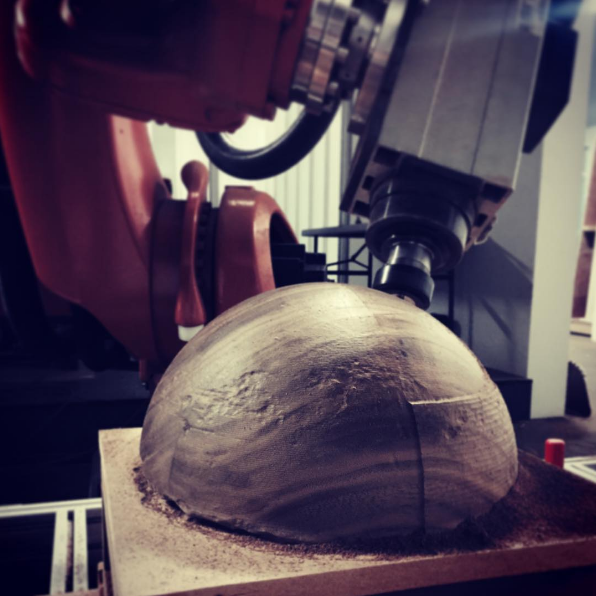
High-efficiency machining can mean different things to different manufacturers, including maximizing material removal rate, reducing computing load, and improving process workflow. Robots are a popular route to achieving higher efficiencies, but there are some important strategies to remember to get the most from them.
Although the term efficiency means a few different things, robots can be a highly effective way to improve almost all types of efficiency when used correctly. However, the lower structural stiffness of robots means that high-efficiency milling needs special attention.
With the right strategies (e.g. posture planning, chatter suppression) and the right CAM software, you can achieve high-efficiency milling with industrial robots.
In this guide, we look at what it means to have high efficiency in machining and how you can use robots to achieve it.
What “Efficiency” Actually Means in Machining — and Why It Matters
The word efficiency is used in at least four different ways in manufacturing. Before you try to create a high-efficiency robotic milling cell, it is useful to consider what type of efficiency you are actually trying to improve.

Here is a brief comparison of what efficiency means in manufacturing:
| Type of Efficiency | What It Measures | Where You’ll See It |
|---|---|---|
| Machine efficiency (OEE) | Availability × Performance × Quality | Production floor management, maintenance |
| Process efficiency | Material removal rate, cycle time, surface finish per pass | CAM strategy comparisons, toolpath optimization |
| Computing efficiency | Processor load, algorithm calculation speed | Academic robotics papers, simulation software |
| Robotic efficiency | Vague catch-all: flexibility, cost, throughput | Robotics marketing and some research literature |
Let’s look at these in a little more detail:
1. Machine Efficiency (OEE)
Overall Equipment Effectiveness (OEE) is an extremely common metric in manufacturing. It’s an industry standard for measuring the productivity of any particular machine.
An OEE of 100% would mean that your manufacturing process only produces good parts as fast as possible, with no downtime and at the required quality standard. Machines with a world-class OEE benchmark at around 85%.
2. Process Efficiency
For most manufacturers, high-efficiency machining means process efficiency. This is a measure of how much material a machining process removes, how fast, and at what surface quality.
In robotic machining, process efficiency presents both the greatest potential and the greatest challenges for many setups.
3. Computing Efficiency
Computing efficiency is a metric that shows up in some robotics research,. It describes how little processor load a control algorithm requires to run.
As a manufacturer, computing efficiency is probably less important to you than process or machine efficiency in terms of improving your production output.
4. Robotic Efficiency
The term efficiency is often used to market robotic systems. Unlike more specific robotic terms like repeatability or payload, the efficiency of a robot has no standard definition.
If you see a particular robotic system marketed as being high-efficiency, it’s worth doing a little digging to find out what the manufacturer actually means by this.
Why Robots Are a Reliable Route to High-Efficiency Machining
Robots offer several structural advantages that can contribute to both machine efficiency and process efficiency.
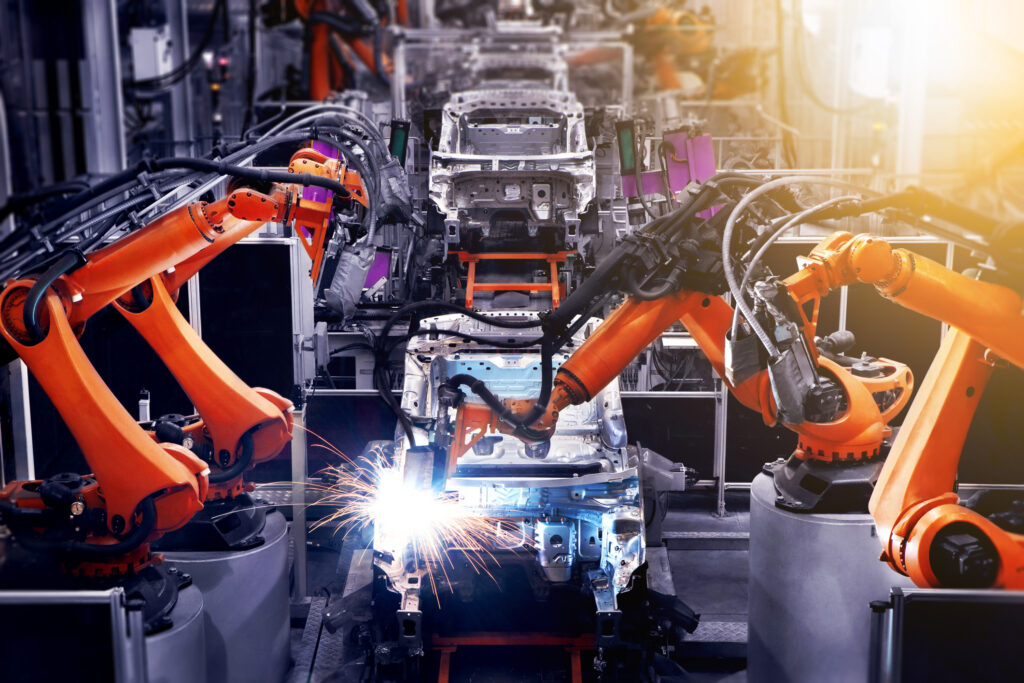
A few benefits of robots for improving machining efficiency include:
- Larger work envelope — Compared to conventional CNC machines, robots have a larger, more flexible work envelope. A robot arm can easily reach around a large, complex part and eliminate multi-setup operations that reduce the machine efficiency of conventional CNC machines.
- Multi-operation flexibility — A single robot can run an entire range of operations within a single cell, including milling, drilling, grinding, and finishing. As well as operational efficiency, this helps you to gain more from your budget, as each process would otherwise need a dedicated machine.
- Reprogrammability — Changing from one part design to another is often simpler with a robot than with conventional CNC machines. For high-mix, lower-volume productions this is a major efficiency gain over fixed CNC tooling.
For many applications, robotic machining is becoming a valuable route to higher efficiency, whatever definition of the word you choose to use.
3 Core Challenges of High-Efficiency Robotic Machining (and Strategies to Solve Them)
But robots also present challenges to high-efficiency machining, specifically when we’re talking about process efficiency and maximizing high-speed material removal.
Compared to conventional CNC machines, robots have lower structural stiffness, which can introduce issues in machining tasks. However, there are reliable strategies to overcome them.
Three common challenges and solutions are:
Lower Material Removal Rate → Dynamic Milling Strategies
Industrial robots typically have a stiffness between 0.1 and 1 N/μm while conventional machines are typically above 50 N/μm. This means conventional machines are roughly 50 to 100 times stiffer than a robot. This can limit the speed at which you remove material with a robot to avoid undesirable vibrations.
One solution to this lower material removal rate is to use dynamic milling strategies. This involves reducing the milling speed in areas of the workpiece that would introduce deflecting forces. An example is to maintain consistent radial engagement rather than allowing the cutting forces to spike when the robot moves around corners.
Posture-Dependent Performance → Posture Planning
A robot’s stiffness can vary significantly depending on its joint configuration at any given point on the toolpath along a single cutting pass. One posture could be highly stiff and stable while another point is prone to “chatter” (undesired vibrations caused by dynamic interactions between the tool and workpiece).
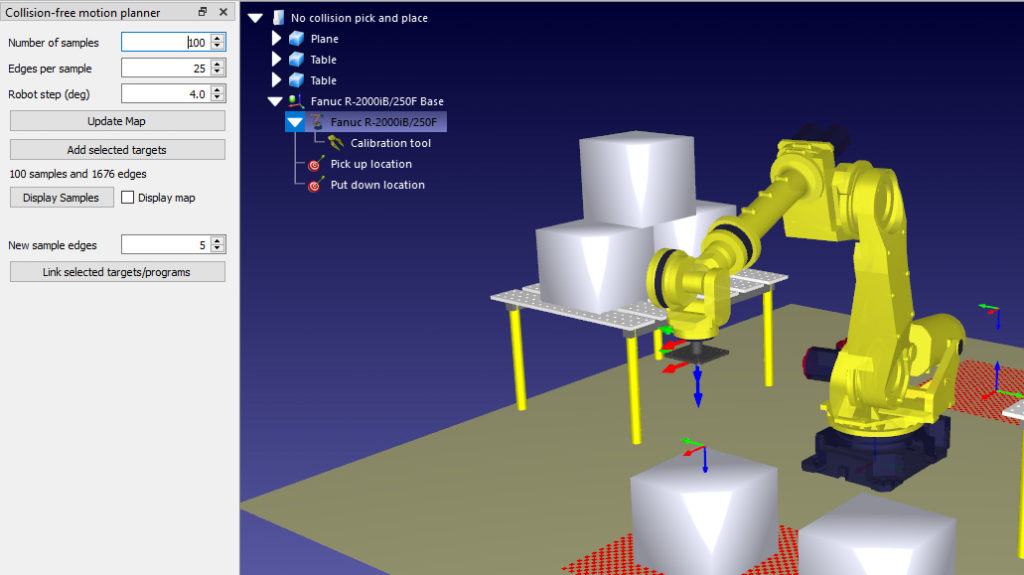
A solution to this is posture planning. Using a suitable robot programming software, you optimize the robot’s joint configuration to maximize the stiffness in the direction of cutting force.
Chatter → Stability Lobe Analysis
Robotic milling can produce two distinct types of chatter:
- Regenerative Chatter — Common in high-speed milling, regenerative chatter is a destructive vibration caused when a cutting tool moves over a previously machined surface of the workpiece containing chatter marks.
- Modal Coupled Chatter — This type of chatter mainly occurs in the robot itself. It produces vibrations of greater amplitude and can be more destructive than regenerative chatter. A solution to reducing the effect of chatter is stability lobe analysis. This involves creating a map of which spindle speeds and cutting depths avoid chatter for your specific robot, tool, and material combination.
How to Choose the Right Software for High-Efficiency Robotic Machining
A highly effective way to test different strategies is to use the right CAM software. You want to use software that’s designed for robotics, offering an entire machining workflow within a single software tool.
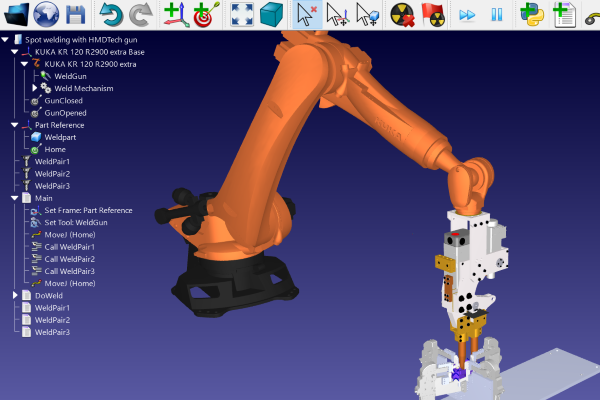
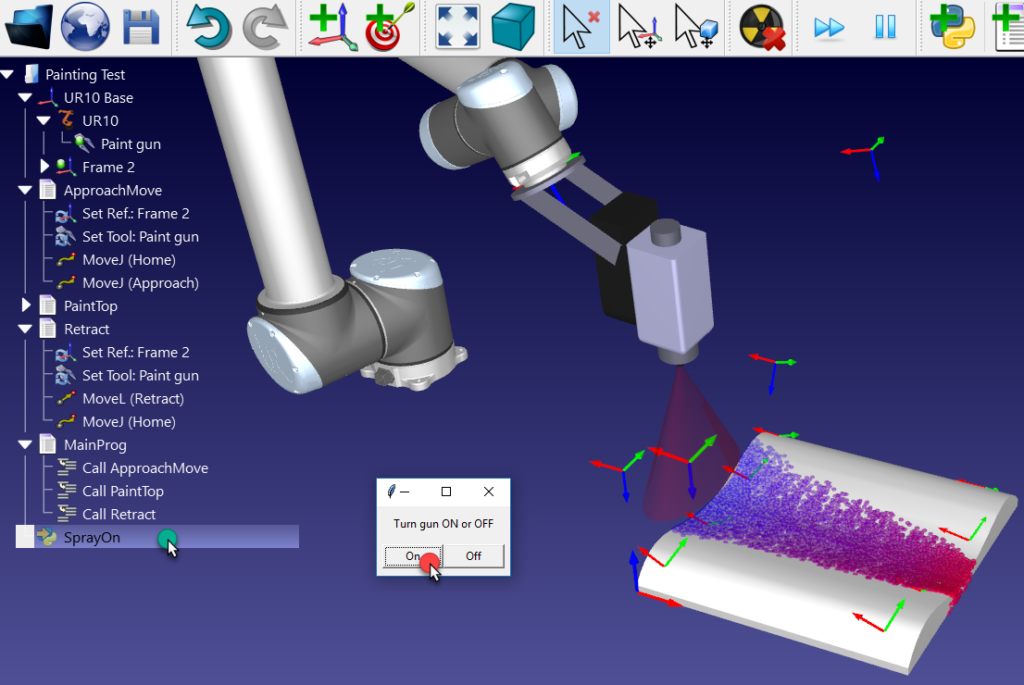
RoboDK CAM is built specifically for this. Its key capabilities for high-efficiency robotic machining include multi-axis toolpath generation, adaptive patterns including zigzag and spiral strategies, adjustable approach and retract motions with customizable clearance planes, and full robotic simulation before deployment.
Simulation capability is particularly important for robotic machining efficiency. Because robot stiffness and chatter behavior are posture-dependent and hard to predict analytically, it’s a good idea to validate programs in simulation before you deploy them to a physical robot.
For more information, check out the RoboDK-CAM product page.
Which challenge most often affects the efficiency of your machining process? Join the discussion on LinkedIn, Twitter, Facebook, Instagram, or in the RoboDK Forum.. Also, check out our extensive video collection and subscribe to the RoboDK YouTube Channel