Known for high-precision CNC industrial robots, MABI Robotic is a Swiss manufacturer specializing in additive manufacturing. Here’s what you need to know to get the most from your MABI robot and how to program one efficiently.
With MABI’s expertise in high-precision manufacturing solutions, the company is making waves in applications like large-structure milling, mobile machining, and even shipbuilding.
In this programming guide, we discuss what makes MABI robots different, what models they offer, and how you can program them more effectively for your chosen application.
The MABI Robotic Story: Swiss Engineering Meets CNC Robotics
MABI Robotic AG is a leading Swiss manufacturer of high-precision industrial robotics, headquartered in Veltheim, Switzerland.
The company’s roots were planted when its parent company, Maschinenbau Biland, was founded in 1969. Over the following decades, the group went through several iterations before the robotics division — MABI AG-Robotic — was formally established in 2018.
The company is best known for its MAX series of 6-axis robotic arms, launched in 2020. These robots combine high-stiffness, advanced CNC control, and innovative encoder technologies to achieve high-precision CNC automation.

While the company only offers a small product range, with 3 robotic manipulators at the time of writing and a few dedicated components, this small range focuses on quality and allows them to service a wide range of industries.
What distinguishes MABI Robotic from many of its competitors is its commitment to entirely local development, with both production and assembly in Switzerland. This is a rarity in modern robotic manufacturing and keeps quality control tight.
What Makes MABI Robotic’s MAX Series Different
MABI Robotics’ mission is to “unite the world of machine tools with that of robotics.”
To achieve this, the company has built its MAX Series robots around a unique set of features:
1. SINUMERIK Control
Instead of a standard robot controller, MAX robots are controlled via the Siemens SINUMERIK CNC ONE. This is a leading-edge CNC control system designed to maximize machine tool productivity. It helps optimize engineering processes by combining multiple CNC technologies with scalable processing hardware and digital twin technology.
2. Secondary Encoders
A defining technical feature of MAX robots is that they include a secondary encoder on every axis. Each encoder sits outside its corresponding joint, measuring the precise link position rather than inferring the position from the motor position as in many robots. This eliminates the error caused by motor backlash and joint compliance, allowing MABI robots to achieve an impressive repeatability of 0.02 mm.
3. Ecosystem of Automation Components
Though MABI’s product catalog is small, it is also mighty. The company offers a range of automation components, including the MLR-2500-P linear rail, rotary tables, and various dedicated accessories.
The unique way that MABI structures its robotic solutions means that they often look more like a CNC machining center than a conventional industrial arm.
Key Applications: Where MABI Robots Are Deployed
With its focus on robotic machining, MABI has developed some impressive applications alongside its expertise.
A few of these include:
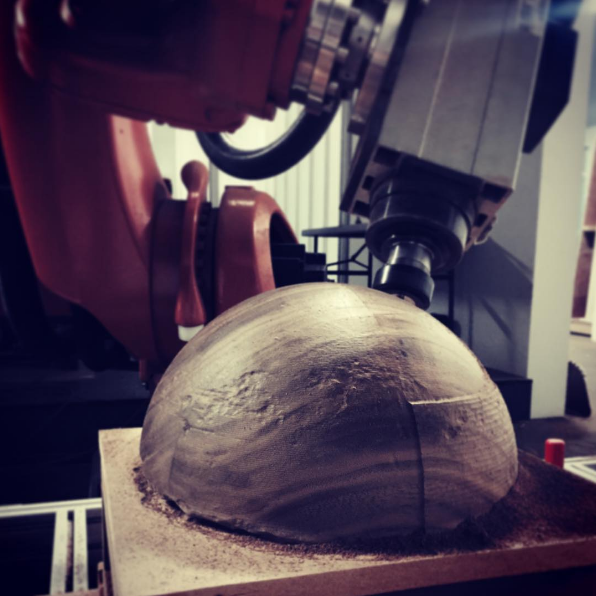
- CNC Milling of Large Structures — With a standard CNC milling machine, the work envelope is fixed and limited. This application involves extending the envelope with linear rails to allow machining of welded constructions, large structural components, and assemblies that would be impossible on a conventional machine.
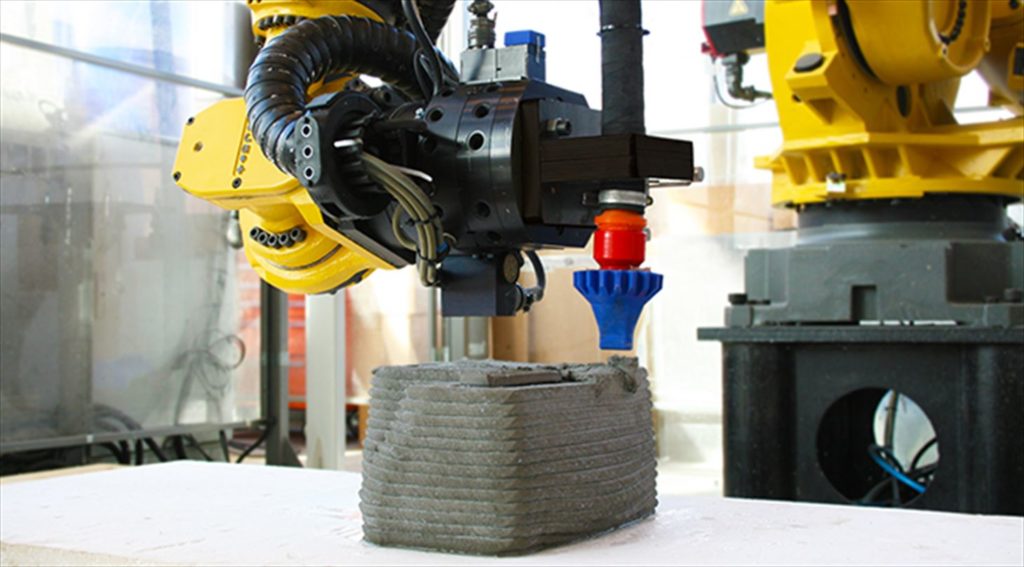
- Additive and Subtractive Manufacturing — With laser deposition welding for large-scale metal 3D printing, metal powder is applied and fused directly onto a workpiece. One application involved building up a steel ring by additive welding, reducing raw material requirements by up to 33%, then finish-milling in the same cell using an interchangeable spindle.
- Battery Tray Finishing — MABI has also developed a dedicated application for electric vehicle production. Aluminium battery trays are finished with post-welding or post-casting machining of pockets, surfaces, holes, and threads.

Spotlight on 3 MABI Robotic Models in the RoboDK Library
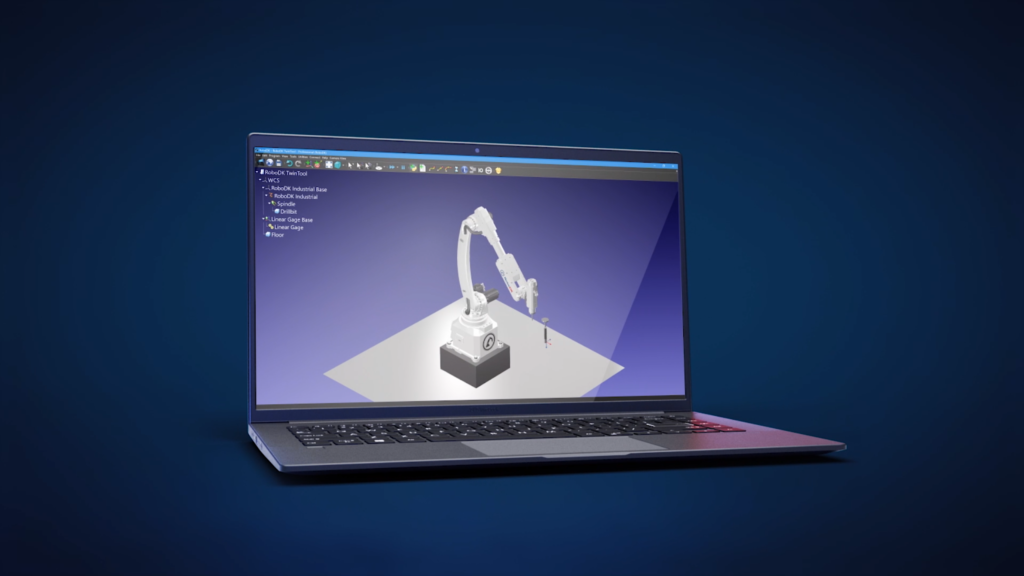
RoboDK supports MABI’s MAX Series of robots in our extensive Robot Library. This means you can quickly download the robot and begin programming it in a simulated virtual environment within minutes.
Each model comes in two variants. The BASIC doesn’t support CNC milling because it does not include the second encoder. The PRECISION includes the second encoder and supports CNC milling.
Here are three of their models:
Robot 1: MABI Robotic MAX-100-2.25-P

The compact entry into the MAX Series, the MAX-100 is a high-stiffness robot providing a payload of 100 kg. It has a reach of 2.24 and a repeatability of 0.02 mm.
The MAX-100 is suited to machining a range of materials, including wood, plastic, carbon fiber, and aluminum.
Robot 2: MABI Robotic MAX-150-2.0-P

As MABI’s mid-range robot, the MAX-150 provides 50% extra payload capacity of 150 kg, with a slightly smaller reach of 2 m and a repeatability of 0.02 mm.
This extra payload allows the MAX-150 to support applications requiring heavier tools like large-scale milling spindles and laser deposition heads.
Robot 3: MABI Robotic MAX-200-2.5-P

The heaviest model, the MAX-200 offers a 200 kg payload capacity and repeatability of 0.02 mm.
With the longest reach at 2.5 m, the MAX-200 is well-positioned for large-format industrial applications in industries like aerospace and energy.
Programming MABI Robotic Robots with RoboDK
With all MAX Series models supported by RoboDK, programming MABI robots is both simple and powerful.
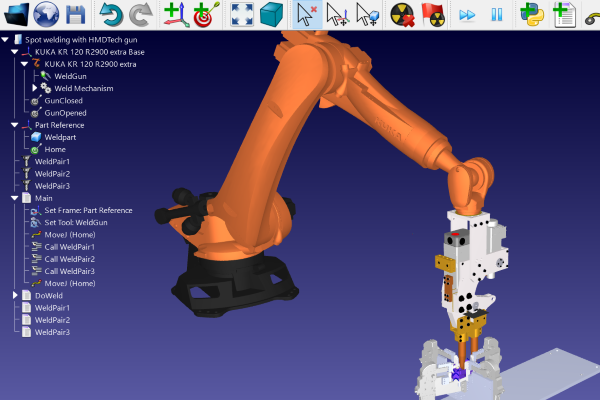
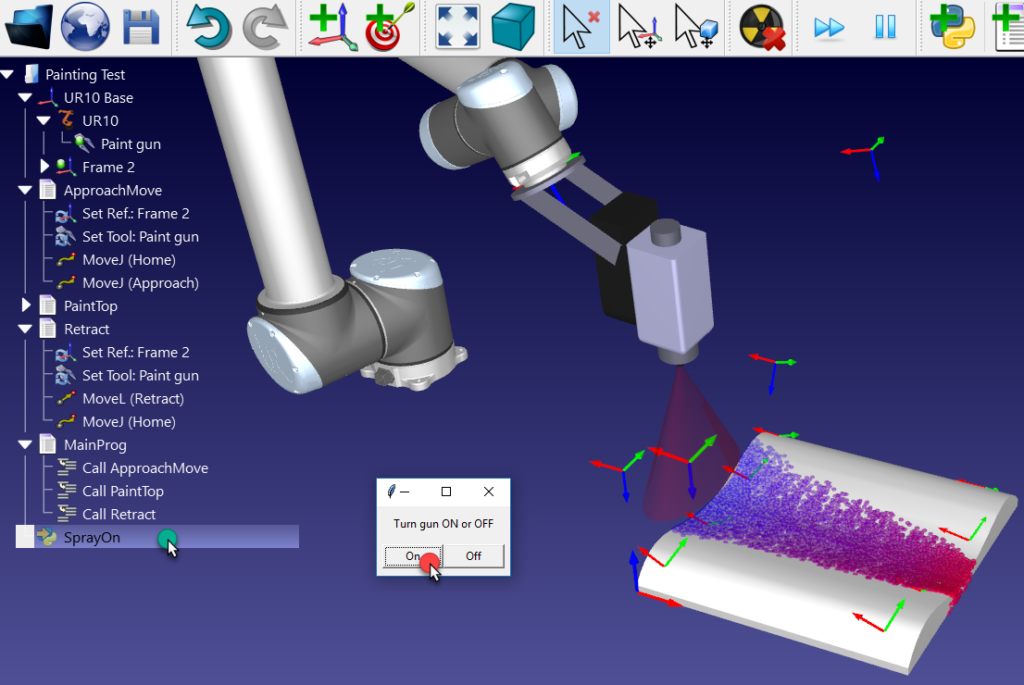
You can use RoboDK’s simulation-first programming environment for a complete workflow, including:
- Importing toolpaths directly from your chosen CAD/CAM software into the simulation environment.
- Validating robot motion in 3D, with automatic collision detection.
- Generating MABI-compatible robot code ready for deployment on the Siemens SINUMERIK controller.
- Extending automation workflows with advanced robotic functionality through the powerful RoboDK API.
To get started, download a trial copy of RoboDK and load your chosen MABI Robotic model from the integrated library.
Looking Ahead: MABI Robotic’s Position in Precision Manufacturing
MABI Robotic occupies a clearly defined niche: the intersection of CNC machine tool precision and industrial robot flexibility.
At RoboDK, we have been advocating for robotic machining for a long time now. With companies like MABI pioneering the introduction of machining-first robots, we are excited to see what new technologies arrive in precision manufacturing over the next few years.
What machining application would you like to perform with a robot? Tell us in the comments below or join the discussion on LinkedIn, Twitter, Facebook, Instagram, or in the RoboDK Forum.. Also, check out our extensive video collection and subscribe to the RoboDK YouTube Channel