Advanced robotic surface finishing involves a range of strategies that go beyond basic force-controlled sanding or polishing. These strategies open up a whole new set of possibilities by combining factors like adaptive impedance control, multi-axis toolpath generation, and robot-specific CAM software.
If you are a manufacturer already using or considering robotic finishing, these advanced strategies can help you gain even more from your automated surface finishing solutions. They can provide a whole host of benefits, including supporting variable surface conditions, complex multi-axis surfacing, and improved tool and stock management.
Here’s how you can use advanced surface finishing techniques and deploy them quickly and easily using the right robot programming CAM software.
Why Standard Force Control Hits a Ceiling on Complex Parts
For surface finishing, force control is one of the most important control factors in robotics. It allows the robot to adapt to the changing forces between the tool and the workpiece surface as detected by a force sensor.
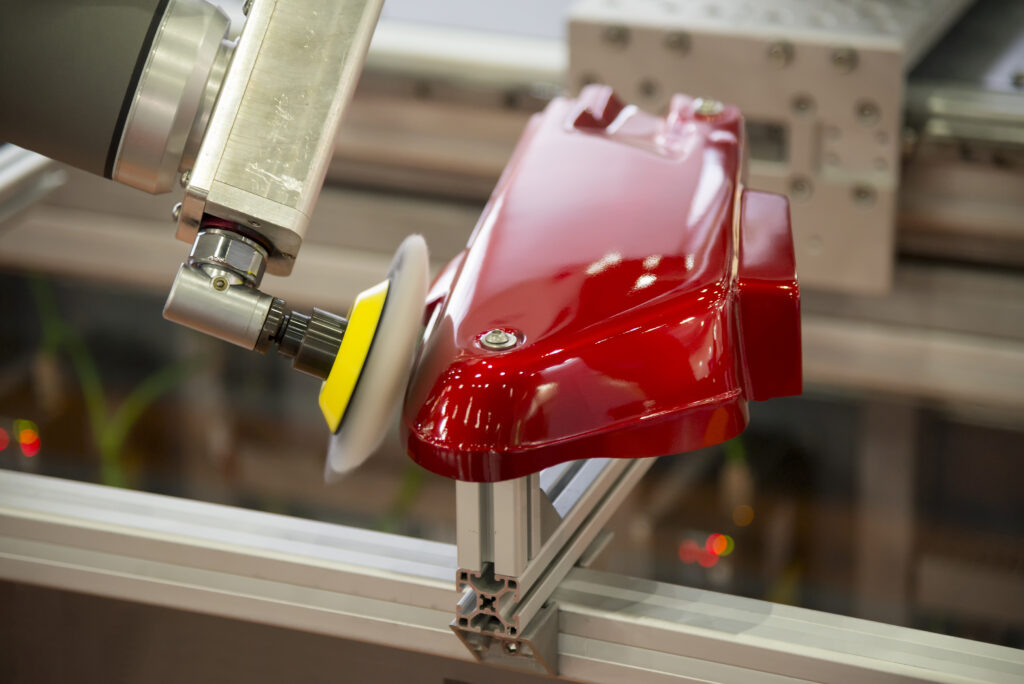
But standard force control often hits a ceiling for complex parts. According to a research review paper, simple control strategies like position control and hybrid position/force control are not always enough.
1. Basic Robot Control Strategy — Standard Position Control
The most basic industrial robot control strategy, position control robots do not have force feedback and so suffer from well-documented limitations for surface finishing.
Specific failure points of position control include: insufficient sensing, an inability to adapt to variation in the workpiece surface, and high cost of reprogramming.
2. Current Industry Standard: Hybrid Force/Position Control
The current industry standard for surface finishing, hybrid position-force control, solves these basic problems by separating motion into two decoupled sub-problems
- Position control is used to direct the robot along the toolpath.
- Force control is only applied along the normal direction to the work surface.
This works well for predictable, well-defined geometry but assumes that contact conditions will remain constant. This assumption often breaks down on complex surface finishing tasks, like those often found in aerospace turbine manufacturing and other components where curvature, material hardness, and surface conditions all vary continuously.
Adaptive Impedance Control: One Next Step
The solution? Adaptive impedance control addresses the limitations of standard approaches directly.
Instead of holding force and stiffness parameters fixed throughout the operation, an adaptive impedance system continuously adjusts its stiffness or compliance based on real-time feedback of how the robot is behaving at the point of contact. Researchers identify this as a highly promising direction for overcoming the core shortcomings of standard force control.
Examples of tasks where adaptive impedance control works particularly well are:
- Finesse Finishing — For complex curved surfaces like turbine blades, it helps to adapt when the contact handle and material removal rate will change continuously.
- Variable-hardness Workpieces — Mixed-material workplaces present an interesting problem where force control either under-removes material in hard regions or over-removes it in soft regions. Adaptive impedance control can help to solve.
- Compliant Robotics — The control strategy is also useful when the control algorithms must account for the robot’s own intrinsic flexibility, not just the tool-workpiece interaction.
Of course, there are other advanced surface finishing strategies beyond adaptive impedance control. But this is an example of one that can solve many manufacturing problems through a change of force control algorithm.
Collaborative Human-Robot Finishing: When Full-Automation Isn’t the Goal
Another advanced strategy that is growing in interest is moving away from the assumption that robotic surface finishing means full automation. Human-robot collaboration using cobots offers some interesting strategic benefits for advanced surface finishing.
By splitting the work of a surface finishing application between a collaborative robot and a human operator, you can:
- Automate the most routine, repeatable portion of the task with the robot.
- Reserve the more complex, judgment-dependent steps for skilled human workers.
- Reduce the cost of automating by focusing only on the steps that are easy to achieve with a robot
- Get the most from both your surface finishing robot and your human team members.
When you are using a robot for advanced surface finishing, consider the possibilities of collaboration between humans and robots. Often, manufacturers forget this option in their attempt to automate, making life a lot harder for themselves than necessary.

Choosing CAM Software for Advanced Robotic Finishing
A key decision when you set out to deploy an advanced robotic finishing cell is what CAM software you will use. Despite there being a range of software options available, it’s rare to find software that supports robotics, let alone advanced force control algorithms.
Some features to look out for in CAM software include:
- Synchronized multi-axis motion control — For systems that involve more than a single robot arm, the software should seamlessly support programming of external axes.
- Full control over process parameters — It should be easy to fine-tune process parameters like approach and retract motions, and clearance planes.
- Adaptive cutting and finishing patterns — Support for various adaptive cutting and finishing patterns allows you to match the tool motion to the specific material removal characteristics that you need.
- Vendor-agnostic robot post-processor support — Look for software that supports many different robot brands with processes for many robots, many models. RoboDK supports over 1000 different models that are available immediately in our extensive Robot Library
- API for advanced control algorithms — For access to advanced control algorithms, look for a tool that includes a reliable API. This allows you to easily integrate both your own code and third-party libraries to speed up adding advanced surface finishing strategies.
RoboDK-CAM addresses all of these needs and more in a combined robot programming and computer-aided manufacturing tool. With post-processors for dozens of popular robot brands, you can easily incorporate advanced finishing strategies into a complete CAD/CAM workflow without the need for external tools.

Getting Started with Advanced Robotic Finishing Using RoboDK
Implementing advanced finishing strategies is certainly more complex than basic automation. However, deployment doesn’t need to be an arduous task.
RoboDK-CAM’s simulation-first approach directly tackles some of the more complicated elements of advanced surface finishing. With functions for complex multi-axis tool paths, integrated collision avoidance, and a host of other features supporting advanced surface finishing, you can quickly employ these strategies and validate them with a digital twin before you deploy them to the physical robot.
For more information, check out the RoboDK-CAM product page.
Which advanced service finishing strategies are you most interested in deploying? Join the discussion on LinkedIn, Twitter, Facebook, Instagram, or in the RoboDK Forum.. Also, check out our extensive video collection and subscribe to the RoboDK YouTube Channel