Manufacturing optimized software refers to digital tools for streamlining, automating, and continuously improving production processes. But, not all robotic software is optimized for manufacturing.
Robots are very common in manufacturing. However, that doesn’t mean they are necessarily “manufacturing optimized.” When you are choosing robotics software, it’s important to consider how it will fit within your wider ecosystem of connected software tools.
In this article, we explore what is meant by manufacturing optimized software, how the right robot software can improve production, and what to consider when choosing between different software tools.
What is Manufacturing Optimized Software?
Manufacturing optimized software is not a single type of tool. However, a category of interconnected software solutions designed to improve every stage of a manufacturing process. These combine simulation, real-time data, and analytics to allow manufacturers to increase productivity and improve product flow.

For robotics, this means choosing a programming tool that “plays nicely” with the other software in your manufacturing workflow. A simple example is that the tool should work seamlessly with any CAD/CAM packages that you already use.
Your own manufacturing software workflow will be unique to your stage of business growth. Software needs will vary depending on whether you are in early-stage product design or scaled global production.
Why Optimization Matters in Modern Manufacturing
The importance of optimization has grown dramatically with the rise of Industry 4.0, where manufacturing systems are often defined by their connectivity, data, and automation. These days, manufacturing environments involve complex networks of automated machines, manual work stages, and software platforms.
The problem? The more software tools you add, the more complex your entire production becomes. System-level optimization is the only way to reliably reduce this complexity because it is not usually caused by one single software tool alone.
With robotics, software optimization is especially important as robots are often used for tasks that were previously done by humans — and humans are more easily able to adapt to changing manufacturing demands.
Research into robotic manufacturing shows that effective software optimization can lead to:
- Substantial increases in throughput and reliability.
- Significant reductions in operational costs.
- Improved utilization of automation equipment.
- Identification of production bottlenecks.
- Increases in production quality.
Crucially, such improvements aren’t achieved by simply “adding a new software tool.” They involve assessing the entire automation workflow, ideally in a dedicated simulator, and incrementally improving the process.

5 Common Types of Manufacturing Software
There are software tools you might use in a manufacturing environment, with features ranging from inventory management to production planning.
Here are 5 common types of manufacturing software you might come across:
- Enterprise Resource Planning (ERP) — These tools operate at the business level with features to manage inventory, customers, and procurement. They don’t manage production but instead provide a strategic framework for running an efficient business.
- Process Planning and Simulation — Almost any manufacturing process can be simulated, including logistics, material handling, and machining. Dedicated simulation tools allow you to optimize these processes.
- Manufacturing Execution Systems (MES) — More common for large-scale production, these systems help large companies manage supply chains across multiple production sites. They are necessary for global companies.
- Computer Aided Design and Manufacturing (CAD/CAM) — At the individual production level, CAD/CAM software is used to create product designs and program machining tools.
- Robot Simulation and Offline Programming— Finally, robotics software adds another layer of optimization that focuses on creating automated cells that fit seamlessly within your wider production.
Individually, each software tool can provide value. But the actual power comes from considering how these software tools interconnect and optimizing the connections between them.
How the Right Robot Programming Software Helps Optimize Manufacturing Environments
Though not traditionally considered alongside tools like ERP and MES, robot programming software is a core component for manufacturing optimization. In any type of scaled production, robots are not isolated tools; they often tackle critical production stages that counteract key bottlenecks.
The most effective robot programming software will facilitate efficient, scaled production without adding extra software complexity. The tool should integrate seamlessly with your existing CAD workflow and offer functionality to further optimize your application for features like multi-robot synchronization, industrial connectivity, and precision alignment.
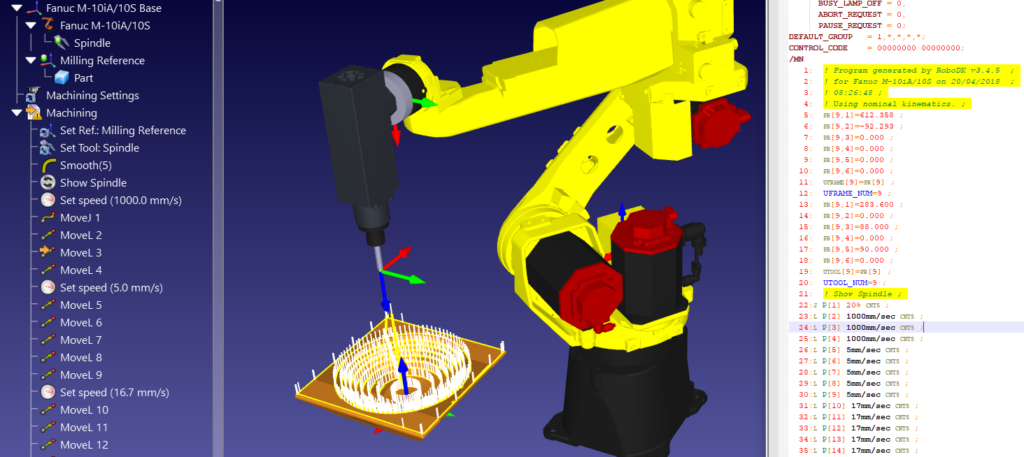
A tool like RoboDK-CAM is specially designed for manufacturers to move directly from product design to robot production as efficiently as possible. It provides a complete workflow from your CAD models to the physical robot application.

How to Choose the Right Manufacturing Software Solution for Robotics
Selecting the right manufacturing software requires a clear understanding of your current needs, growth plans, and wider business processes.
A first step is to clarify why you are using robots and what business goals you aim to meet with them. This will help you narrow down the features that are necessary in your robot programming software.
For example, if your aim is to incorporate robotic machining into your process, a tool like RoboDK-CAM could be a good contender. However, if you are instead looking for robotic inspection, it’s more important that the software integrates with the right metrology sensors.
A good rule of thumb is to aim for simplicity wherever possible. If you can achieve a result with one software tool, it usually makes more sense to do this rather than trying to connect multiple software tools together using custom scripts.
Final Thoughts: Software Optimization Is an Ongoing Practice
Whatever specific tools you choose, it’s helpful to think of manufacturing software optimization as an ongoing business practice. Similar to the philosophy of continuous improvement.
Each time you are considering adding a new software tool to your workflow, pay attention to how it might affect other stages in your production.
As production systems become more interconnected, it’s becoming more and more important that manufacturers can manage software complexity. This is why a manufacturing-optimized approach to software is becoming a competitive advantage. Solutions like RoboDK-CAM are one example of this shift playing out in practice. By simplifying robot programming, such tools allow you to more easily integrate robotics into your wider manufacturing workflows.
What types of manufacturing software do you use? Join the discussion on LinkedIn, Twitter, Facebook, Instagram, or in the RoboDK Forum.. Also, check out our extensive video collection and subscribe to the RoboDK YouTube Channel